Conricus: Carl Bildt is wrong as usual

Security expert Jonathan Conricus slams Carl Bildt after his claim that Iran ”did not have the intention to develop nuclear weapons.” Conricus states that Bildt has ”a long history of supporting terrorist organizations” and believes the Israeli military operation Rising Lion will lead to increased stability in the region.
Swedish-Israeli security expert Jonathan Conricus, senior advisor at the security consultancy FDD and former colonel and spokesperson for the Israeli military, harshly criticizes former Swedish Foreign Minister Carl Bildt after his latest statement following Israel’s launch of the military operation Rising Lion inside Iran.
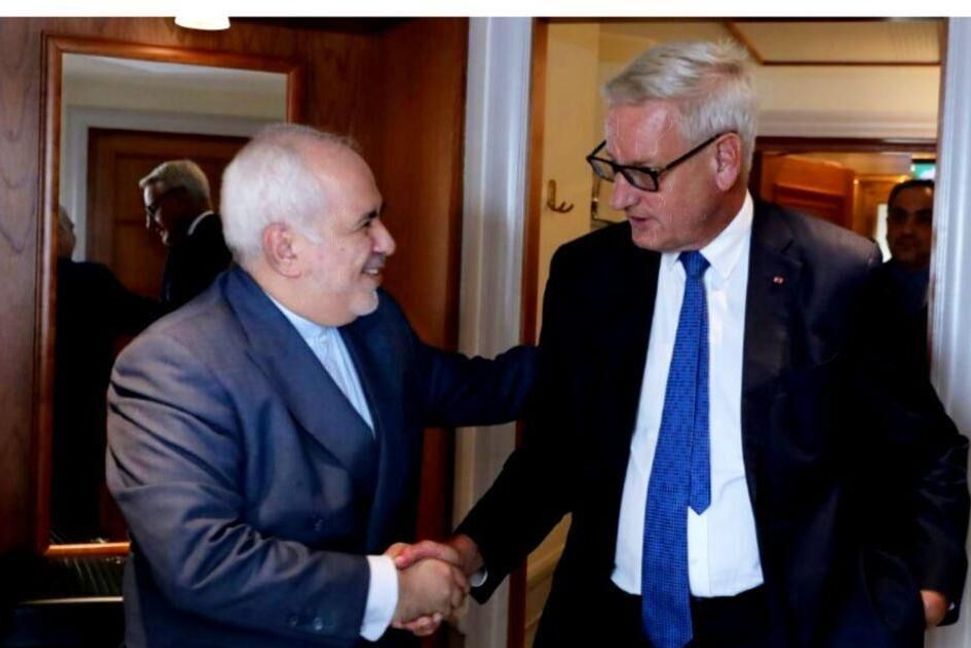
On X, Carl Bildt claims that Iran ”did not have the intention to develop nuclear weapons, but now it’s highly likely it will.” Bildt also argues that Netanyahu ”launched the war he always wanted.” Bildt has previously met with Iran’s Foreign Minister Javad Zarif in 2019 under friendly circumstances (after Bildt’s term as FM), which created criticism from the Moderate Party’s Hanif Bali.
Harsh criticism of Bildt
The other day IAEA [the Atomic Energy Agency] stated that Iran had violated its commitments not to try to manufacture nuclear weapons. Today Carl Bildt writes on X that Iran ”did not have the intention to develop nuclear weapons.” What do you say about Carl Bildt’s analysis?
”I don’t know what information he has access to, but I can definitely say that he is completely wrong. [Carl Bildt] has a long history of supporting terrorist organizations and undemocratic regimes in the Middle East,” said Jonathan Conricus.
”[All facts about Iran’s nuclear weapons ambitions] will probably be made public very soon and show that Carl Bildt is wrong again. Carl Bildt has the ability to always be on the wrong side of history, especially when it comes to Israel,” said Jonathan Conricus.
Successful operation
Operation Rising Lion has been very successful so far and surprised the Iranian regime, according to Jonathan Conricus.
”[Israel] has managed to take out Iran’s air defenses and about ten different nuclear weapons-related sites in Iran and has also managed to eliminate at least four very important Iranian commanders in the military, both in the regular army and the Revolutionary Guard, which is the most important military force in Iran,” said Jonathan Conricus.
”And I think the most important thing is that [Israel] has been able to do all this [and] surprise Iran. And so far Iran has not had the ability to strike back against Israel in any significant way,” he said.
Mossad smuggled in drones
The Israeli intelligence service Mossad has played a central role in the operation.
”Mossad has even released video footage showing Mossad agents inside Iran [who] prepare various weapons systems [and] drones that have been smuggled into Iran by Mossad and which were then used in the first attack against various targets in Tehran and against various other military targets,” said Jonathan Conricus.
”So it’s obvious that Mossad has been very busy and successful here in preparing everything, gathering information and preparing the attack. They have a very large and probably very well-established network of agents inside Iran who have conveyed information in real-time about where [the] Iranian commanders were located. Something that made it possible to [take out] so many simultaneously,” he said.
Over a year of preparations
How much work goes into preparations for such a military operation? How long has Israel been planning this?
”I think it’s about at least a year because [the] military intelligence work needed to be able to map all of Iran’s nuclear weapons installations and where the various commanders are located and understand the very structure of the entire system in Iran, that involves several years of being active inside Iran and gathering intelligence and mapping everything,” said Jonathan Conricus.
”And then of course it’s about having the air force that must be ready, equipped. Logistically it’s also very, very complicated, it’s something you have to prepare and train for several months to be able to do. And so far, thank God, it has been very successful, all the pilots who have flown to Iran [have] returned safely to Israel, something that you probably didn’t think would be possible,” he said.
Iran responded with drones
Unlike last fall when Iran fired two hundred missiles at Israel, Iran has this time so far only sent drones in response. Jonathan Conricus sees this as a sign of Israel’s success in first taking out Iran’s ballistic missile capability.
”What I think has affected how Iran has been able to respond is that Israel, after taking out and eliminating several important commanders in the Revolutionary Guard and air defense, attacked the various bases where the ballistic missiles are stored and fired from. Israel knew that Iran would try to respond and therefore the first thing they did was to take out that capability,” said Jonathan Conricus.
Conricus: Leads to increased stability
How does this affect stability in the Middle East in the short and long term?
”We have high alert right now in Israel [and also at Israeli embassies around the world] and [Israel’s military operation is] definitely something that short-term maybe can cause instability but long-term [and already in the medium term] I think it’s about a liberation from a threat, something that can be incredibly positive for the Iranian people too and for the region,” said Jonathan Conricus.
”Hopefully this will lead to something positive. The Iranian Islamic regime has been one that has exported violence and terrorism throughout the area, in Iraq, in Syria, in Lebanon, in Yemen, Gaza Strip, and Judea and Samaria. That Iran is now weakened, that will improve the situation in the entire Middle East.”
”It will weaken various terrorist organizations in the area and hopefully we will see a better future for people in the region, for the Iranian people, for Israelis but also for Sunni Muslims who live in the area,” he said.
[SOURCE: Interview, paragraphs 1-12]